Dinner Interrupted
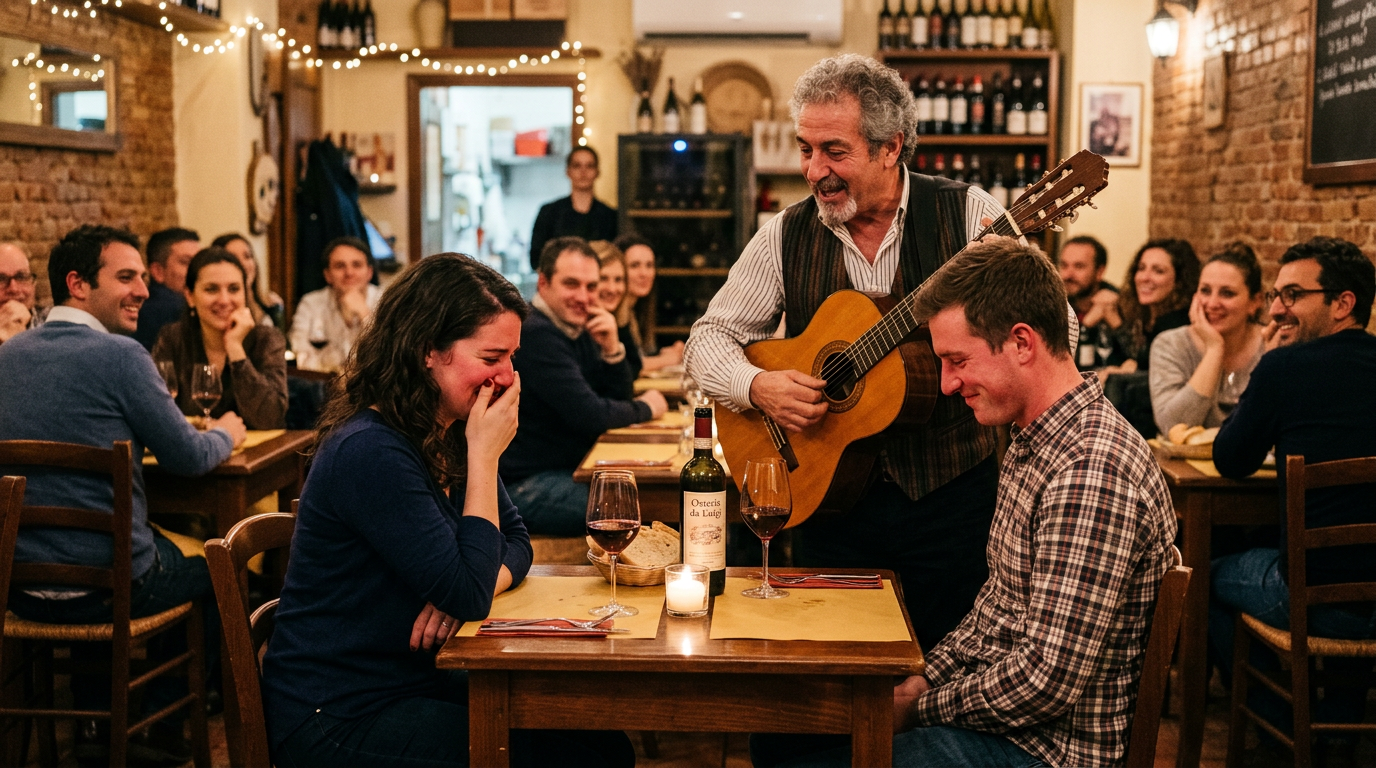
The other night I went to an Italian restaurant with colleagues.
They came from abroad to visit the Copenhagen office, and every year when that happens, we pick a restaurant together.
We settled in, browsed the menu, and took in the place—warm lighting, good smells, the sound of clinking glasses.
Everything felt right.
And then I saw him.
A cheerful man striding through the restaurant with a guitar strapped across his chest.
And I thought: ah… we’re not alone.
I knew what was about to transpire.
He was roaming between tables, making eye contact like a predator scanning the savanna.
And I made the fatal mistake.
I looked up. Our eyes met. It was over.
That wasn’t just eye contact—that was a legally binding agreement.
He changed direction and started walking toward our table.
There’s no opt-out. No “unsubscribe from live music.”
Once he locks in, that’s it. You’ve been selected.
Within seconds, he was next to me—three inches from my ear—playing "That’s Amore".
A song that means absolutely nothing to me.
But there I was, pretending it's the soundtrack to my life.
And here’s the thing nobody tells you: the moment the musician arrives, you become a performer too.
You didn’t sign up for this.
You came for pasta.
Now you’re an audience member in a show you never bought tickets for—and you have to look enthusiastic.
You have to smile. Nod along. Maybe clap.
There’s a delicate sweet spot: too much and he’ll play a second song;
too little and your colleagues think you’re a soulless corporate robot.
For the introverts among us, this isn’t dinner.
It’s a hostage situation.
The whole restaurant is watching your table.
You’re trapped between the musician, your Bolognese, and 30 strangers silently judging whether you’re enjoying it enough.
You are the sacrificial lamb of the evening.
As long as he’s playing for you, every other table can eat in peace.
They’re watching you like a zoo exhibit, faces glowing with pure, unadulterated relief that it’s you and not them.
“Stay strong… buy us time.”
The restaurant becomes a map of infected zones and safe zones.
Your table? Ground zero.
The tables behind the pillar? Switzerland. Neutral. Protected. Blessed.
Everyone is tracking his movements like air traffic controllers, calculating the odds of being next.
And I’m with colleagues. Work people.
So now I have to perform on two levels: enthusiasm for the music and professionalism.
We were mid-conversation, and suddenly everything pauses for a dramatic guitar flourish. I’m trying to look like a serious adult while a man in a vest is aggressively serenading my Bruschetta.
This is not covered in corporate training.
One colleague is loving it—clapping, swaying, thriving, living her best life.
Another is dying inside.
We make eye contact. A silent bond forms. We are allies now. For life.
No words. Just: I see you. We will survive this.
How long does this last?
One song? Two? Is there a set list? An encore? A director’s cut?
Nobody knows.
There’s no programme, no intermission, no emergency exit.
I'm mid-bite into my dish and I can't chew because it feels disrespectful.
My food is getting cold. I'm starving.
But I can't eat because I'm performing. I must respect the arts.
I start calculating escape routes.
Can I go to the bathroom? Would that be rude? Can I pretend I got a phone call?
I’m a grown adult planning an escape from a man with a guitar.
And then—salvation.
He moves to another table. A couple, two tables over. Looks like a first date.
Perfect.
Suddenly it’s romantic over there.
A movie scene.
She’s gazing into his eyes while this man provides the soundtrack.
I’m watching strangers have a beautiful moment.
Wait.
No.
Look closer.
The guy is doing the nod. The fake smile. The polite clap.
The hostage nod.
He’s one of us.
I wish I could save him.
Then the musician finishes, smiles, and lingers.
The guy reaches for his wallet.
And it hits me—he’s not tipping for the music. He’s paying him to leave.
A reverse ransom.
In every other transaction in life, you pay for a service to begin.
Here, you’re paying for it to end.
Come to think of it, this is basically a protection racket.
"Nice dinner you’re having here. Shame if someone were to… serenade it."
The mafia had guns.
This man has a guitar and sustained eye contact.
The result is the same.
There’s clearly an unspoken exchange rate:
Ten kroner—one song.
Twenty kroner—he moves on.
Thirty kroner—he skips you entirely next time.
Fifty kroner—witness protection program.
He finishes. We clap. Relief.
Temporary relief, actually. He’s still in the restaurant.
Will he do another round? Will he come back?
I spend the rest of dinner avoiding eye contact like my life depends on it.
And then the guilt arrives.
This man is working. This is his job. He’s probably a wonderful musician.
And I’m sitting here mentally writing a complaint essay about him.
What does that say about me?
Am I the villain?
But why do we tolerate this?
Maybe we go along because saying “no thank you” feels ruder than suffering in silence. We’d rather be uncomfortable than make someone else uncomfortable.
The social contract strikes again.
Nowhere on the menu did it say “live entertainment included.”
There was no warning. No checkbox.
I consented to eat a bruschetta, not to performing in a concert I never signed up for.
The food was incredible, by the way.
But the restaurant is ruined now.
Because every time someone suggests going back, I’ll think:
The guitar man.
He took that from me.